Current Issue
Vol. 2 (2026)
Published:
2026-02-13
Articles
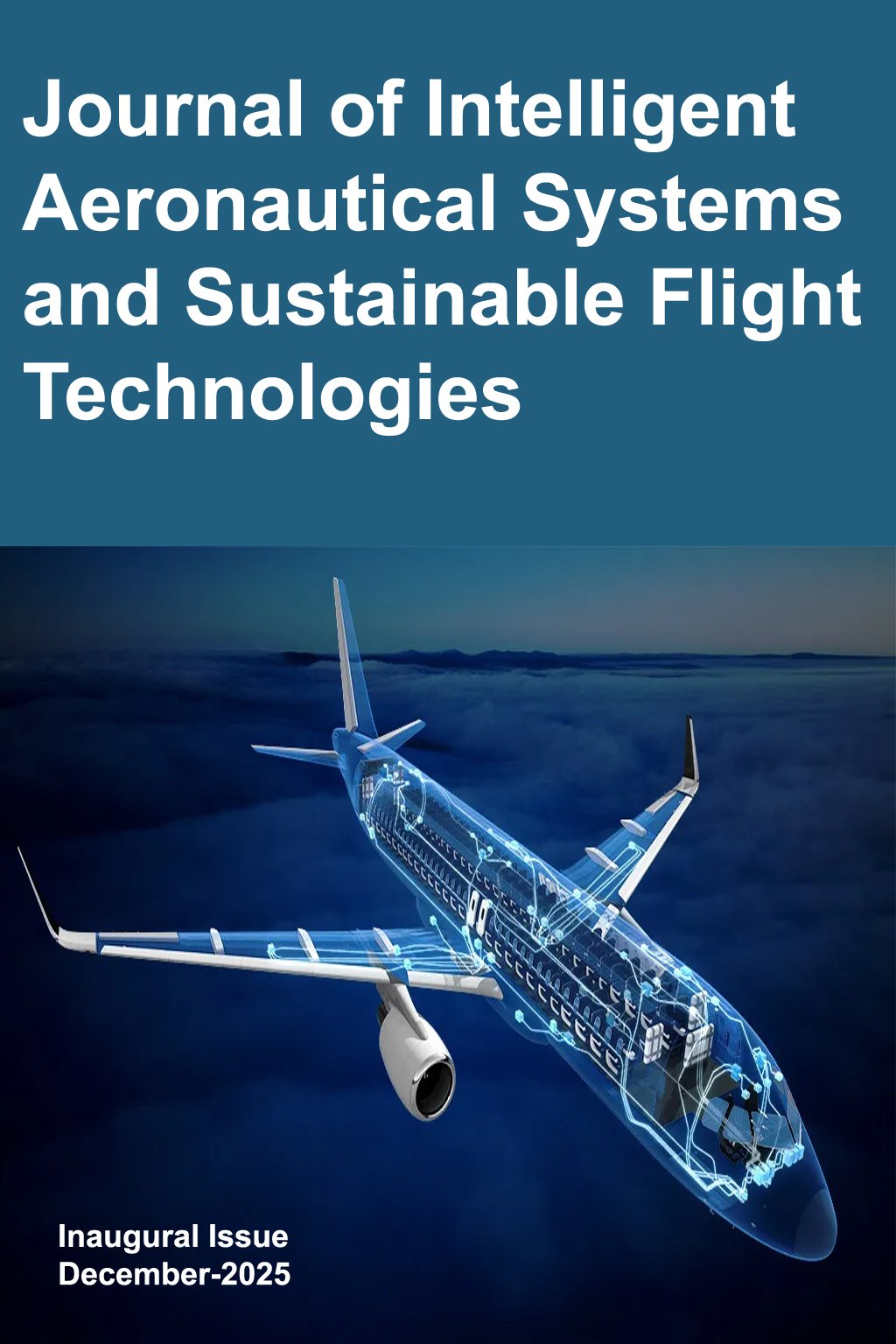
Journal of Intelligent Aeronautical Systems and Sustainable Flight Technologies is a peer-reviewed, open-access journal that provides an international platform for research and innovation in next-generation aeronautics, with particular emphasis on the convergence of intelligent systems, sustainability, and automation. It brings together emerging developments and established areas of aeronautical engineering to advance the design, modelling, analysis, control, optimization, and operation of safer, more efficient, sustainable, and intelligent flight systems. The journal welcomes interdisciplinary contributions addressing technological advances that are shaping the future of aircraft, unmanned aviation, propulsion, aero-structures, flight operations, and associated aerospace systems.
Aim and Scope:
The journal aims to advance scientific knowledge and engineering innovation in aeronautics by publishing high-quality research addressing emerging technologies, methodologies, systems, and applications for current and future aviation. Particular emphasis is placed on research that improves aircraft performance, operational efficiency, autonomy, safety, environmental sustainability, and intelligent decision-making through advanced engineering, computational, digital, and data-driven approaches.
The journal welcomes theoretical, computational, experimental, and applied research covering, but not limited to:
Artificial intelligence and machine learning applications in aeronautical engineering
Advanced aircraft aerodynamics, modelling, simulation, and optimization
Novel, sustainable, hybrid-electric, and other emerging propulsion technologies
Unmanned aerial vehicles (UAVs), autonomous aircraft, and autonomous flight systems
Advanced flight guidance, navigation, and control systems
Smart aerostructures, adaptive structures, and morphing wings
Sustainable aerospace materials, manufacturing, and aircraft production technologies
Digital twins, virtual modelling, simulation, and real-time flight analytics
Aeroacoustics, aircraft noise prediction, control, and reduction
Aviation and aircraft safety, reliability, certification, and regulatory considerations
Human–machine teaming and intelligent human–aircraft interaction
Artificial intelligence, big data, and intelligent technologies for air traffic management
Environmental influences on aircraft, aviation systems, and flight operations, including mitigation and adaptation strategies
Aircraft energy efficiency, emissions reduction, and sustainable aviation technologies
Integration of intelligent, automated, digital, and data-driven technologies across aeronautical systems
Emerging technologies, methodologies, and interdisciplinary perspectives relevant to the future of aeronautics.
The journal particularly encourages research that connects aeronautical engineering with artificial intelligence, automation, digital technologies, sustainability, advanced materials, computational methods, and intelligent systems, while maintaining a broad scope across fundamental and applied aeronautical research.
Target Readership
The journal is intended for an international readership of aeronautical and aerospace engineers, aircraft designers, aerodynamics and propulsion specialists, flight-control and avionics researchers, UAV and autonomous-flight specialists, aerospace materials and manufacturing researchers, artificial intelligence and machine-learning researchers, computational scientists, aviation safety and certification professionals, air traffic management specialists, sustainability researchers, academics, industry practitioners, technology developers, regulators, and policymakers. It also provides a valuable resource for postgraduate researchers and students engaged in aeronautics, aerospace engineering, intelligent aviation systems, automation, sustainable aviation, and emerging flight technologies.